
Leadership at Work Happens in the Smallest Moments
It’s not about the quarterly boardroom speech. It’s about the way you show up—moment by moment.
From how you open a Zoom call to how you handle a tough conversation, leadership at work is defined by presence, purpose, and consistency. Thoughtful leadership isn’t episodic—it’s everyday. Over the past decade, coaching hundreds of professionals, I keep coming back to one core question:
How do you lead with both impact and empathy?
Today’s workplace demands more than authority—it demands emotional fluency, intentional communication, and the ability to pause before responding. No reinvention required—just small, strategic shifts.
1. Start with Intention, Not Reaction
Before stepping into any meeting—virtual or face-to-face—take a moment to reset:
- What energy do I want to bring?
- What outcome matters most—results and relationships?
That pause shifts your state from reactive to aligned. As Viktor Frankl wisely noted:
“Between stimulus and response there is a space. In that space is our power to choose our response. In our response lies our growth and our freedom.” Reddit
That space is where leadership at work truly begins.
2. Lead Conversations, Not Just Agendas
Meetings shouldn’t be checklists—they’re moments to connect. Instead of saying “Any questions?” try:
- “What feels unclear or unfinished?”
- “What concerns are on your mind?”
These invitations make honesty possible. Simon Sinek perfectly captures its importance:
“Leadership is not about being in charge. It’s about taking care of those in your charge.” Reddit
That’s leadership at work in microcosm—prioritizing people.
3. Leadership at Work Happens in the Micro-Moments
Trust is built not during town halls but in everyday exchanges: check‑ins, follow‑ups, and how you respond when things go wrong.
—Research from Deloitte shows that 94% of employees in psychologically safe environments are more likely to innovate.
“No one cares how much you know, until they know how much you care.” Theodore Roosevelt
That’s leadership at work: meeting emotional currency with action.
4. Practice Emotional Fluency
Emotionally intelligent leaders don’t ignore feelings—they name them, explore them, and help others do the same. Daniel Goleman, who popularized emotional intelligence in leadership, said it best:
“If your emotional abilities aren’t in hand…you are not going to get very far.” Life Success Journal
And in supporting others, Eleanor Roosevelt reminds us:
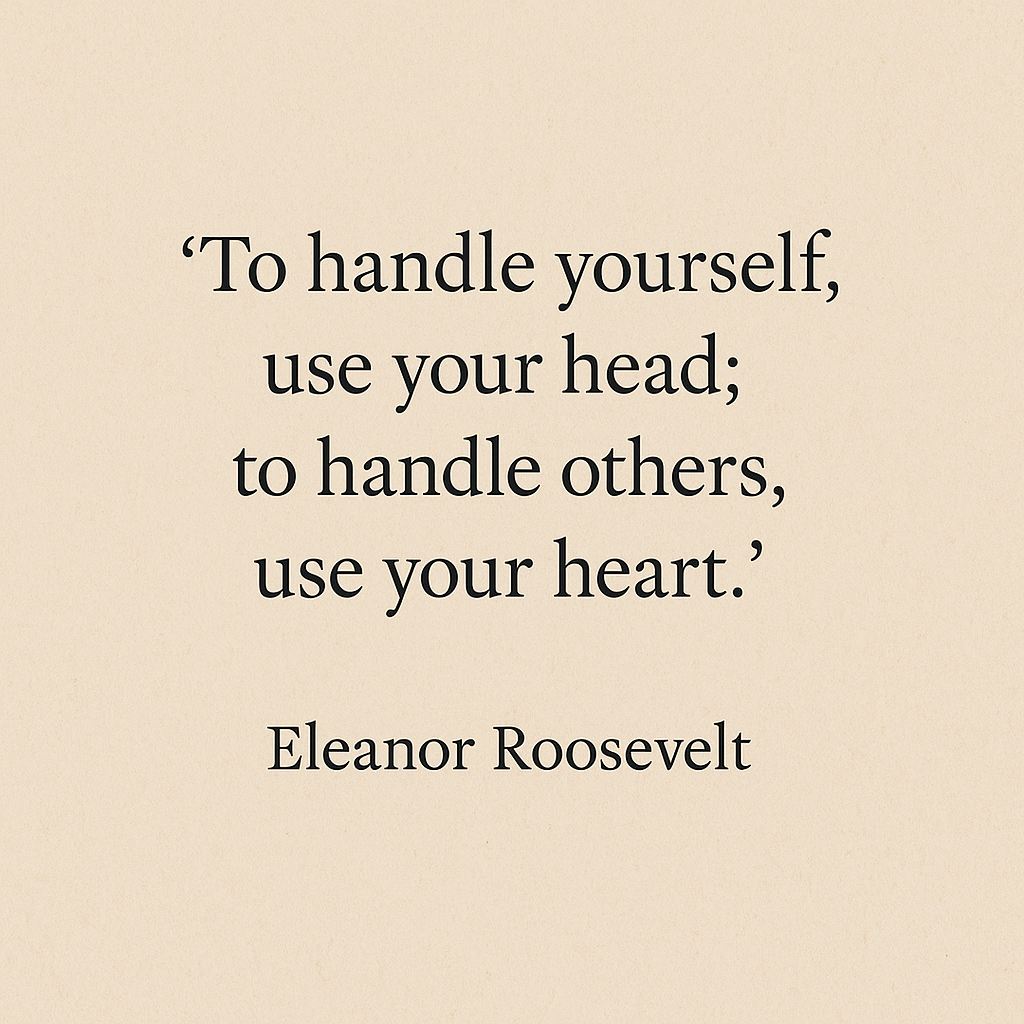
“To handle yourself, use your head; to handle others, use your heart.” Eleanor Roosevelt
Building emotional fluency—that’s leadership at work in action.
5. Leadership at Work: Walk the Talk, Lead by Example
Your actions speak louder than words. Want to create a culture of work‑life balance? Don’t send late‑night emails. Want psychological safety? Don’t interrupt.
Robert K. Greenleaf, founder of the servant leadership movement, believed true leadership is service:
“The best test of a leader is how much they serve others.” Wikipedia
That’s leadership at work—living values visibly.
Why Leadership at Work Matters
“Emotional intelligence is the sine qua non of leadership.” —Daniel Goleman, LinkedIn
Studies show that emotional intelligence—or EI—is a stronger predictor of leadership effectiveness than IQ alone. That means something as simple as pausing, listening, and empathizing can raise team performance and innovation—without fancy programs or titles.
Your Next Steps
You don’t need a promotion to lead better. You need a fresh lens—seeing every interaction as a leadership at work moment:
| Practice | Why It Matters | What to Do |
| Pause before meetings | Shifts your energy intentionally | 1-minute calm before the storm |
| Replace “Any questions?” | Encourages honest dialogue | Try: “What feels unclear to you?” |
| Offer empathy for mistakes | Builds psychological safety | Pause, listen, say: “Tell me more.” |
| Name emotions | Increases trust and clarity | “I’m feeling frustrated—what about you?” |
| Model your values | Sets the standard | No midnight emails if you value balance |
Each moment becomes an opportunity to model clarity, build trust, and lead with humanity.

Conclusion
Effective leadership in the modern workplace hinges on a delicate balance of emotional intelligence, adaptability, and purposeful vision. When leaders actively listen, demonstrate empathy, and model transparent communication, they forge deeper connections with their teams—fostering trust and inspiring engagement. Moreover, by encouraging creativity and reevaluating traditional hierarchies, leaders empower diverse voices to innovate, accelerating both individual and organizational growth. This approach not only drives results but also cultivates a culture of resilience and belonging.
In today’s rapidly evolving world, leadership is not static—it is an ongoing journey of learning and adaptation. As organizations confront technological disruptions, shifting workforce expectations, and global complexities, responsive and empathetic leadership becomes indispensable. By committing to self-reflection, continuous learning, and setting an example, leaders can inspire clarity of purpose and inspire excellence. Ultimately, leadership at work is about uniting people toward a shared goal while nurturing a supportive environment that honors each individual’s contribution—because when leaders invest in their teams, the entire organization thrives.
→ Ready to lead with more clarity, trust, and impact?
Explore how I help professionals elevate presence and performance: mollyrudberg.com